
The Tacitura™ Method
Extracting what experience actually exists
The Tacitura™ Method is a structured approach to extracting tacit knowledge — the judgement, mindset, and experience people carry but rarely document — so it can be transferred, reused, and sustained.
It exists to address a problem most organisations recognise but struggle to solve:
their most valuable knowledge is often the least visible.
The challenge with tacit knowledge
Tacit knowledge is not procedural. It is shaped by experience, context, and judgement developed over time.
While many sophisticated knowledge management systems exist, they focus primarily on the organisation and delivery of knowledge once it has already been made explicit. They assume the hard work of extraction has been done.
In practice, that assumption rarely holds.

A methodology focused on extraction, not storage
The Tacitura Method is a structured methodology for extracting tacit knowledge — the mindset, judgement, and contextual understanding that sit beneath formal processes and documentation.
It operates upstream of systems, tools, and platforms, concentrating on the act of extraction itself. The method is grounded in years of coaching, mentoring, and leading teams, and is built around knowing which questions to ask, when to ask them, and how to recognise meaning as it emerges.
This is where the value lies.
How the Tacitura Method works
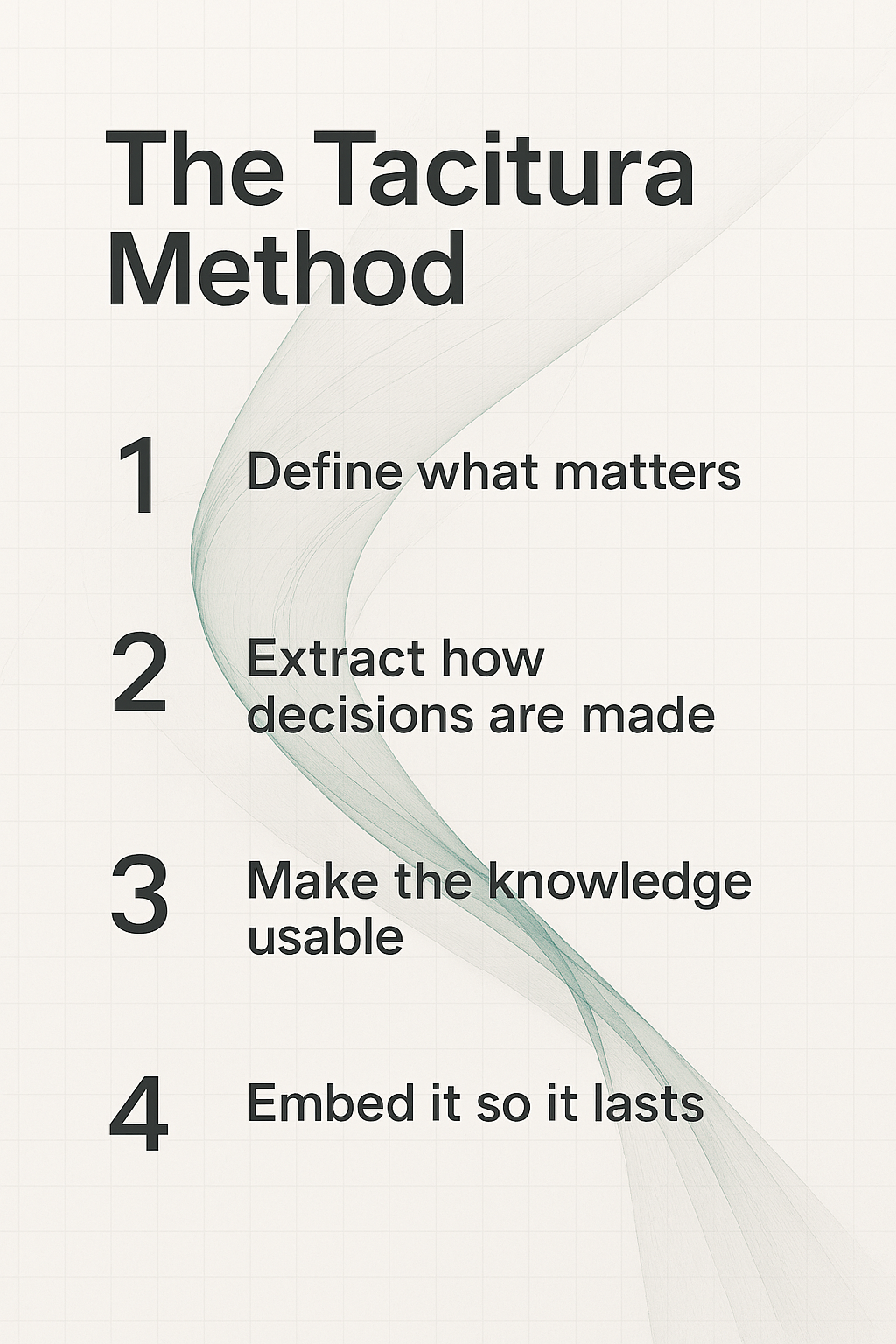
The method follows a disciplined four‑step sequence. Each step is designed to be clear, purposeful, and outcome‑focused.
1. Define what matters
(Framing)
This step establishes clarity before any knowledge is captured.
It identifies:
the decisions the knowledge must support
the risks of getting those decisions wrong
the boundaries of what is worth capturing — and what is not
The aim is focus: ensuring effort is directed only at knowledge that materially affects outcomes.
2. Extract how decisions are made
(Elicitation)
This step focuses on how experienced people actually think and decide in real situations.
Through structured, targeted questioning, it surfaces:
judgement built through experience
decision logic and trade‑offs
assumptions that are rarely written down but routinely relied upon
The emphasis is on real decision‑making, not job descriptions or formal processes.
3. Make the knowledge usable
(Synthesis)
Here, raw insight is consolidated and structured so others can understand and apply it.
This involves:
making implicit reasoning explicit
removing noise while preserving context
organising knowledge around real decisions, scenarios, and risks
The output is practical, decision‑ready knowledge — not generic documentation.
4. Embed it so it lasts
(Transfer)
The final step ensures the knowledge can be used beyond the individuals who originally held it.
Knowledge is prepared so it can be:
shared consistently
reused across teams or roles
integrated into existing documents, processes, or AI‑enabled environments
The focus is on use and continuity, not storage.
What is actually being captured
The Tacitura Method does not attempt to capture “everything someone knows.”
It focuses on:
how experienced people see situations
how they make decisions
what they notice, prioritise, or disregard
how context shapes action
In other words, it captures mindset — the part of knowledge that is hardest to replace and easiest to lose.
Technology as an enabler, not the method
AI is used selectively within the Tacitura Method to support speed, consistency, and synthesis. It does not define the method and it does not replace human judgement.
The method is designed so that technology assists thinking, rather than directing it.
Outputs and integration
Outputs from the Tacitura Method are system‑agnostic knowledge assets.
They can be delivered as:
structured text documents or PDFs
reference or narrative materials
formats prepared for integration into existing organisational knowledge or AI environments
However you want
The method focuses on extraction and structuring, not long‑term hosting or system design.
Sharing the method responsibly
The Tacitura Method was developed through applied practice and refined over time. It is now being made available to a small number of Licensed Partners.
The method itself is mature.
The partner model is being developed deliberately.
This allows the approach to scale without losing integrity.
An invitation
Tacitura is seeking early Licensed Partners who value rigour, judgement, and thoughtful practice.
If you are interested in applying the Tacitura Method within your own work, the starting point is a conversation.